
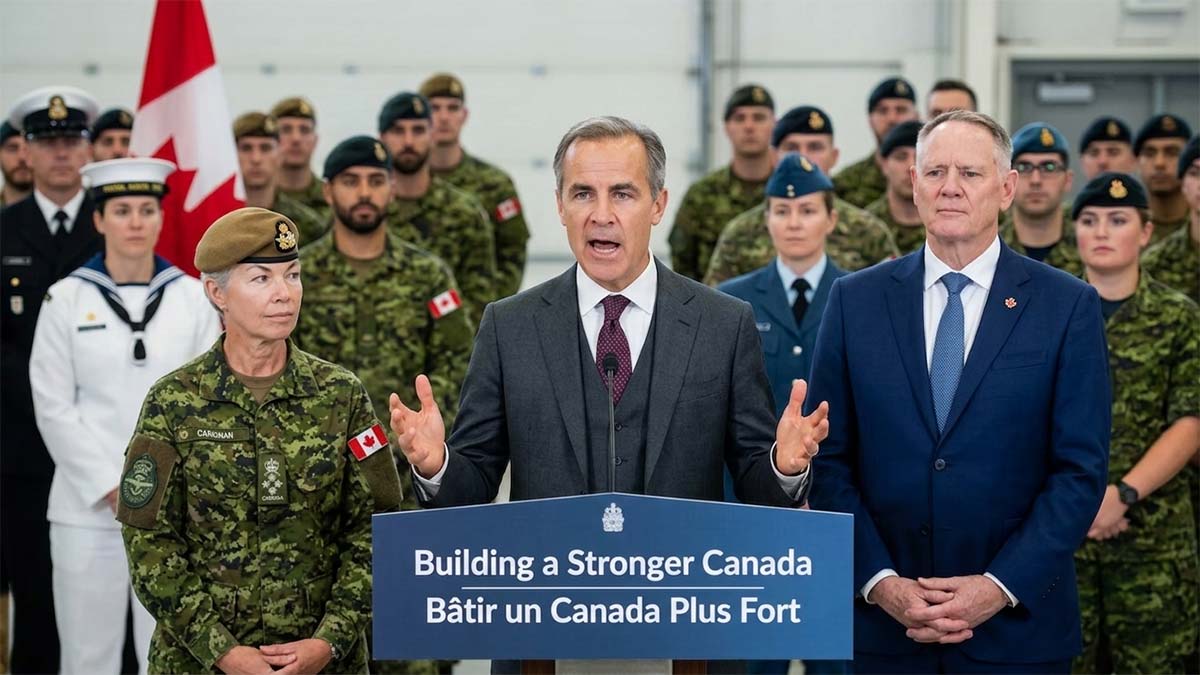
Canada could be heading toward tax increases as the federal government searches for ways to finance a significant rise in military spending. A recent analysis from the C.D. Howe Institute suggests that achieving long-term defence commitments will require difficult financial decisions, including potential increases to the Goods and Services Tax (GST) and tighter control over non-defence spending.
Why Defence Spending Is Set to Rise
Canada has committed to substantially increasing its military budget over the next decade. The report highlights a target of raising defence spending to 5% of GDP by 2035—a dramatic shift compared to current levels.
For context, Canada recently reached NATO’s minimum benchmark of 2% of GDP in defence spending, a goal set by NATO. However, as recently as 2024, under former Prime Minister Justin Trudeau, Canada was spending only about 1.5% of GDP on defence, placing it among countries that had not yet met alliance expectations.
Projected Military Spending Growth
According to the report, Canada’s annual defence budget is expected to rise sharply:
- From just over $60 billion in 2025–26
- To nearly $150 billion by 2034–35
This would effectively triple defence spending within a decade. At that level, military expenditures would rival the large federal transfers Ottawa provides to provinces each year, such as health and social funding.
The Fiscal Challenge Facing Ottawa
The authors, Colin Busby and Nicholas Dahir, emphasize that such a dramatic increase in spending cannot happen without consequences. They argue that the federal government has three main options:
- Raise taxes
- Cut or slow growth in other areas of spending
- Increase borrowing and debt
Without policy adjustments, the surge in defence spending would significantly widen federal deficits.
Possible GST Increase and Revenue Impact
One of the most discussed options in the report is a potential increase in the GST. The analysis estimates that:
- A 2 percentage point rise in GST could generate approximately $25 billion in additional revenue in 2025–26
This would provide a substantial funding boost, helping offset rising military costs without relying entirely on debt.
Economic Pressures Limiting Flexibility
The report underscores several structural challenges that make it harder for Canada to absorb higher defence spending:
- Sluggish economic growth
- Weak productivity performance
- An aging population increasing pressure on public services
- Already elevated levels of federal debt
These factors leave limited room for large-scale spending increases without introducing new revenue sources or making cuts elsewhere.
A “Mixed Approach” to Balance the Budget
Rather than relying on a single solution, the report recommends a balanced strategy. This includes:
- Moderate tax increases, potentially including GST adjustments
- Slower growth in non-defence government spending
The authors argue that this combined approach would allow Canada to meet its defence commitments while maintaining long-term fiscal stability and avoiding an excessive burden on future generations.
Political and Strategic Context
There is broad agreement across Canada’s political landscape that military investment must increase, particularly in light of rising global tensions and security concerns. However, the report warns that governments have historically delayed making the tough financial decisions required to support such commitments.
Meeting future defence targets will likely force policymakers to confront trade-offs that have been avoided for decades.
Conclusion
Canada’s plan to significantly expand its defence budget reflects a changing global security environment and growing international expectations. However, the financial reality behind this ambition is complex. The analysis from the C.D. Howe Institute makes it clear that there is no easy path forward. Whether through higher taxes, reduced spending growth, or increased borrowing, Canadians are likely to feel the impact of these decisions. A balanced approach combining modest tax increases and disciplined spending may offer the most practical solution, but it will still require careful political and economic management in the years ahead.
FAQs
1. Why is Canada increasing defence spending?
Canada aims to meet stronger NATO commitments and respond to rising global security challenges by significantly boosting its military budget.
2. How much could defence spending increase?
Spending is projected to grow from just over $60 billion in 2025–26 to nearly $150 billion by 2034–35.
3. Will taxes increase in Canada?
The report suggests that a GST increase of 1–2 percentage points is a likely option to help fund defence expansion.
4. How much revenue could a GST hike generate?
A 2% increase in GST could bring in around $25 billion annually.
5. What are the alternatives to raising taxes?
Other options include cutting spending in non-defence areas or increasing government borrowing, though each comes with its own risks.