As the city pushes for National Historic Site status by 2027, the controversial plan sparks debate about safety, tourism, and who’s responsible for Canada’s capital
December 4, 2025
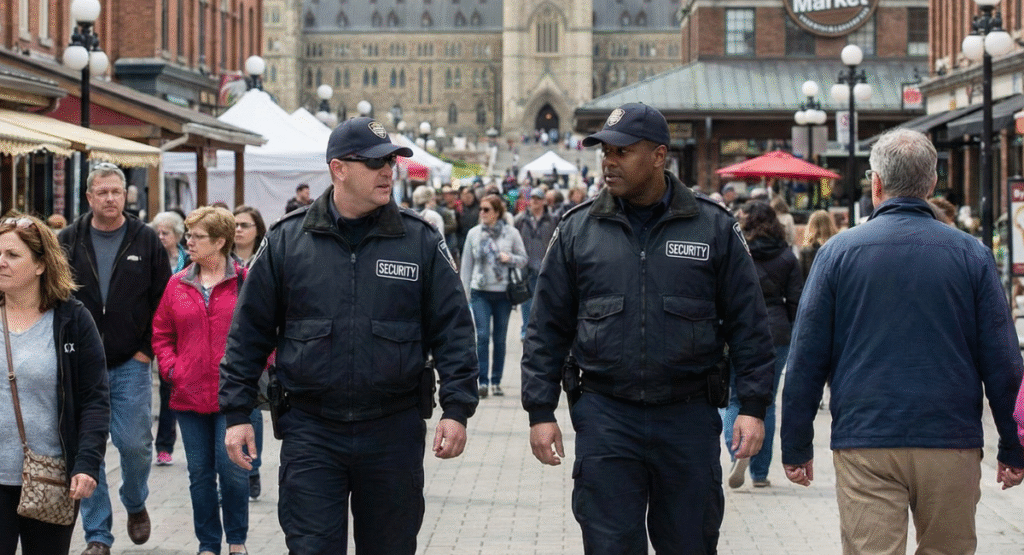
Mayor Mark Sutcliffe stood before cameras today flanked by police brass and emergency service chiefs to announce a solution Ottawa businesses have been demanding for years: private security guards patrolling the ByWard Market.
The price tag? One million dollars over two years from the city’s new Public Safety Action Plan.
The timing? Strategic. Ottawa is racing to secure National Historic Site designation for the Market by its 200th birthday in 2027, and nothing kills tourism faster than safety concerns.
But the announcement raises uncomfortable questions: If one of Canada’s premier tourist destinations needs private security to feel safe, what does that say about our capital city? And is this a real solution or just expensive optics?
The $1 Million Plan: What You Need to Know
Mayor Mark Sutcliffe announced the plan to spend $1 million in new funding over two years to hire private security guards for the ByWard Market, positioning it as part of a comprehensive Public Safety Action Plan.
Key Details:
- Budget: $1 million over two years (approximately $500K annually)
- Purpose: Fill gaps in security coverage alongside existing police and ByWard Market District Authority efforts
- Scope: Private security teams will support small businesses and tourism groups
- Launch: Pilot project begins immediately
- Police support: 14 new officers will be added to the downtown core starting December 15, 2025
According to Police Chief Eric Stubbs, private security represents just one element of a larger strategy. The goal is straightforward: more eyes on the street, better coordination, and a safer environment for the 22 million annual visitors who flock to the Market.
Why This Is Happening Now
The ByWard Market isn’t just struggling with perception—it’s facing real challenges that have been building for years.
The Safety Crisis Nobody Wanted to Admit
For years, business owners have been footing their own security bills while waiting for a coordinated response. Ottawa Markets, which manages the historic ByWard Market building, currently pays $280,000 per year to hire two private security agents—costs that executive director Zachary Dayler described as rising at an unsustainable rate.
And they’re not alone. Condos, hotels, and businesses across the Market have been hiring private firms like TOERSA Security and Blackbird Security for years, each paying thousands monthly for protection that should arguably be a basic city service.
The problems they’re addressing include:
- Harassment and intimidation of customers and staff
- Small-scale theft from retail stores
- Public drug use and dealing
- Aggressive panhandling
- Vandalism and property damage
- Needles and human waste on sidewalks
The National Historic Site Push
Here’s where timing gets interesting. The City of Ottawa wants to turn the ByWard Market into a national historic site in time for its 200th birthday celebrations in 2027.
That designation would put the ByWard Market in the same category as Parliament Hill, the Rideau Canal, and the Diefenbunker—Canada’s most treasured locations. It would bring:
- Increased tourism and international recognition
- A bronze Parks Canada commemorative plaque
- Enhanced “cachet” over provincial or municipal designations
- Potential federal funding for heritage preservation and wayfinding projects
- Leverage for economic development initiatives
But there’s a catch: you can’t credibly push for National Historic Site status while businesses are installing panic buttons and tourists are avoiding the area after dark.
The optics matter. A lot.
The Track Record: Is More Security Actually Working?
Before we debate whether this $1M investment makes sense, let’s look at what’s happened since Ottawa launched its Community Outreach Response and Engagement (CORE) strategy in May 2024.
Crime Statistics Show Progress
Data from the Ottawa Police Service shows assaults declined by 7.8% in the ByWard Market between July 2024 and June 2025 compared to the same period a year earlier.
Even more impressive: robbery charges dropped 30% during the same period, from 53 charges down to 37.
The new Neighbourhood Operations Centre at 50 Rideau Street—a police outpost with a visible street presence—gets credit for much of this improvement. The facility hosts regular meetings of the Integrated Community Situation Table, bringing together 30 members from downtown service providers to address root causes of crime and connect vulnerable people with help.
Chief Stubbs explained the philosophy: rather than just arresting repeat offenders, the integrated approach tries to identify struggling individuals and connect them with housing, mental health services, addiction treatment, and other supports before problems escalate.
So far, the program has generated 35 referrals for people in need.
But Perception Remains a Problem
Here’s the disconnect: crime stats are improving, but many people don’t feel safer.
Rideau-Vanier Councillor Stéphanie Plante noted that residents continue reporting fear to her office, and many have stopped calling police because response times feel too long. She observed that while overall statistics show progress, many businesses still hire private security and power-wash sidewalks daily—suggesting the situation on the ground remains challenging.
The ByWard Market District Authority reported that over 22 million visits were recorded over the past year, marking a return to pre-pandemic numbers. Foot traffic is back. But perception matters as much as reality when it comes to tourism and economic vitality.
The Bigger Context: A Market in Transformation
To understand why $1M for private security is both necessary and insufficient, you need to see the full picture of what’s happening in the Market.
The $129 Million Revitalization
Ottawa isn’t just throwing security guards at the problem. The city has committed $129 million to a comprehensive ByWard Market revitalization that includes:
- Wider sidewalks and pedestrian-friendly streets
- Reduced car traffic with improved bike lanes and transit
- Upgraded market buildings to better support vendors
- Better lighting, waste management, and public amenities
- Heritage preservation alongside modern infrastructure
- Public washroom access (increased by 11 hours)
- 76 new floral planters and heritage-style lighting
The revitalized William Street is expected to be completed by 2027 to coincide with the Market’s 200th anniversary.
The Cluster Problem Nobody Wants to Talk About
Here’s the uncomfortable truth that business leaders mention carefully: the ByWard Market has become a hub for social services, creating what’s known as a “cluster model.”
Within a relatively small area, you’ll find:
- Multiple emergency shelters
- A supervised injection site
- Mental health crisis services
- Food banks and meal programs
- Transitional housing facilities
These services are desperately needed and save lives. But concentrating them in one tourist-heavy commercial district creates friction. Vulnerable people struggling with addiction, mental illness, or homelessness naturally congregate near services. Businesses serving tourists and local shoppers want a clean, safe, welcoming environment.
Everyone’s needs are legitimate. The question is whether we’re managing the tension effectively.
Business leaders increasingly argue that social services should be distributed more evenly across the city rather than concentrated in one economically vital district. It’s a political third rail—nobody wants to be accused of “NIMBYism” or pushing vulnerable people out of sight—but the conversation is happening whether officials acknowledge it or not.
What Other Cities Are Doing
Ottawa isn’t alone in struggling with downtown safety in a post-pandemic world. Cities across North America are grappling with similar challenges:
Vancouver’s Granville Entertainment District uses a combination of private security, police, and ambassador programs. The city-funded security program costs approximately $2M annually and is considered moderately successful.
Toronto’s Yonge Street has deployed both private security and a Streets to Homes outreach team that connects vulnerable people with services. The dual approach—security plus social support—shows better outcomes than either alone.
Montreal’s Old Port maintains a highly visible security presence through a combination of police, private security, and tourism ambassadors who provide directions and assistance while subtly monitoring for issues.
Portland, Oregon tried a similar approach with mixed results—private security helped with petty crime but did little to address underlying issues of homelessness and addiction without accompanying social services investment.
The common lesson: security alone doesn’t solve complex social problems. It can manage symptoms and improve perception, but sustainable solutions require addressing root causes.
The Business Community’s Response
Reaction to today’s announcement has been cautiously optimistic.
Business owners welcome the investment but question whether it’s sufficient. Many have been paying out-of-pocket for years and see $500K annually as a drop in the bucket compared to what’s needed for comprehensive coverage.
Tourism operators are more enthusiastic, seeing it as a necessary step toward restoring the Market’s reputation as a safe, family-friendly destination—crucial for the 2027 bicentennial celebrations and National Historic Site campaign.
Property owners in the Market have mixed feelings. Some see it as vindication of their concerns. Others worry it’s a Band-Aid solution that doesn’t address systemic issues.
The Controversial Questions Nobody’s Asking
Let’s address the elephants in the room:
1. Why Are Taxpayers Subsidizing Private Security?
If businesses were located anywhere else in Ottawa, they’d pay for their own security. The city doesn’t subsidize guards for suburban malls or office parks. So why the Market?
The answer seems to be that the ByWard Market isn’t just a commercial area—it’s a civic asset, tourist destination, and soon (hopefully) a National Historic Site. The city benefits from a thriving Market through tax revenue, tourism spending, and international reputation.
But this creates an uncomfortable precedent. If the Market gets city-funded security, what about Bank Street? Chinatown? Westboro? Other BIAs are already asking why their areas don’t qualify for similar support.
2. Is This About Safety or Tourism Optics?
The timing is hard to ignore. The National Historic Site application is moving forward. The 200th anniversary is coming in 2027. Major revitalization projects are underway.
Cynics might view the $1M security investment as PR designed to change perception just long enough to secure federal designation and boost tourism numbers for the bicentennial.
Optimists counter that it’s a pragmatic response to legitimate concerns that will provide real benefits regardless of motivation.
3. What Happens When the Two Years Are Up?
Pilot projects have a way of becoming permanent—or disappearing entirely depending on politics and budget pressures.
If private security proves successful, will the city commit to ongoing funding? What if the next council decides it’s not a priority?
If it doesn’t work as hoped, what’s Plan B?
The announcement provided no answers about sustainability beyond the initial two-year commitment.
4. Are We Just Moving Problems Around?
Critics of dispersed security approaches worry they simply push vulnerable people from one area to another without solving underlying issues.
If private security makes the ByWard Market less hospitable to people struggling with addiction or homelessness, where do they go? Do we create new problems in adjacent neighborhoods?
Effective solutions require both security AND expanded social services, housing, mental health treatment, and addiction support. Today’s announcement mentioned only the security piece.
What Success Looks Like (And How We’ll Know)
If this initiative works, we should see:
Measurable Improvements:
- Continued decline in reported crime
- Reduced complaints from businesses about theft and harassment
- Increased foot traffic during evening hours
- Higher customer satisfaction scores in tourism surveys
- More businesses investing in the area (renovations, new openings)
- Successful National Historic Site designation by 2027
Qualitative Changes:
- Residents and visitors reporting they feel safer
- Families with children returning during evenings
- Outdoor patios and public spaces being used more
- Fewer businesses hiring additional private security
- Positive media coverage and social media sentiment
The real test will be whether Ottawa maintains momentum beyond the $1M pilot and 2027 celebrations, or if this becomes another short-term initiative that fades when political attention moves elsewhere.
The Bottom Line: Necessary But Not Sufficient
Is $1 million for private security in the ByWard Market a good investment? It depends on your perspective.
If you’re a business owner who’s been paying for security out-of-pocket while crime ate into your bottom line—yes, absolutely. About time.
If you’re concerned about vulnerable populations being pushed aside for tourism optics—it’s complicated, and you’re right to be skeptical about security-only approaches.
If you’re a taxpayer wondering why commercial areas need subsidized security—fair question, though the Market’s unique status as a civic asset provides some justification.
If you’re invested in Ottawa’s reputation as a capital city and tourist destination—this is probably necessary infrastructure, like road maintenance or park upkeep.
The truth is, $1 million isn’t going to solve all the Market’s challenges. It won’t address homelessness, addiction, or mental health crises. It won’t eliminate all crime or make everyone feel perfectly safe.
What it can do is provide visible presence, rapid response to incidents, support for overwhelmed police services, and reassurance to tourists and residents that the city is taking concerns seriously.
Whether that’s worth $1 million over two years depends on whether we see it as part of a comprehensive strategy—or a standalone solution to problems that require much more.
What Happens Next
The pilot project begins immediately, with private security deployment ramping up alongside the 14 new police officers joining the downtown core on December 15.
City council will need to approve funding beyond the initial two-year period, likely sometime in late 2026 or early 2027.
The National Historic Site application will work its way through the federal process, with a decision expected in time for the Market’s 200th birthday celebrations in 2027.
And businesses, residents, and tourists will judge the initiative by the only metric that truly matters: whether they feel safe walking through Canada’s oldest and most iconic market.
Key Takeaways: ByWard Market Security Initiative
The Investment:
- $1 million over two years for private security
- Part of broader Public Safety Action Plan
- 14 additional police officers starting Dec. 15
Why Now:
- Business owners demanding action for years
- Push for National Historic Site designation by 2027
- 200th anniversary celebrations approaching
- Crime improving but perception remains negative
What’s Working:
- Police stats show 7.8% decline in assaults
- Robberies down 30% year-over-year
- New police outpost at 50 Rideau showing results
- Foot traffic back to 22 million annual visits
Ongoing Challenges:
- Concentration of social services creates tension
- Businesses still hiring own security
- Perception lags behind statistical improvements
- Root causes (housing, addiction, mental health) unaddressed
The Real Question: Is this a comprehensive strategy or expensive optics? Time will tell if $1M in security creates lasting change or just shifts problems around.
What do you think? Is private security the answer to the ByWard Market’s challenges, or should Ottawa be investing in different solutions? Share your experiences and perspectives in the comments.
If you own a business in the Market or have visited recently, we want to hear from you. Has safety been a concern? Would this initiative make a difference?
#ByWardMarket #OttawaSafety #OttawaNews #DowntownOttawa #PublicSafety #OttawaBusiness #Tourism #NationalHistoricSite #OttawaPolice #MarkSutcliffe #Ottawa2027