The capital’s office market faces unprecedented uncertainty as the feds plan to shed millions of square feet—and nobody knows which buildings will survive
December 4, 2025
Walk through downtown Ottawa on a Wednesday afternoon and you’ll see something unsettling: empty streets, darkened storefronts, and gleaming office towers filled with vacant floors. It’s not just a post-pandemic hangover. This is the new reality of a capital city wrestling with an identity crisis, and the stakes couldn’t be higher.
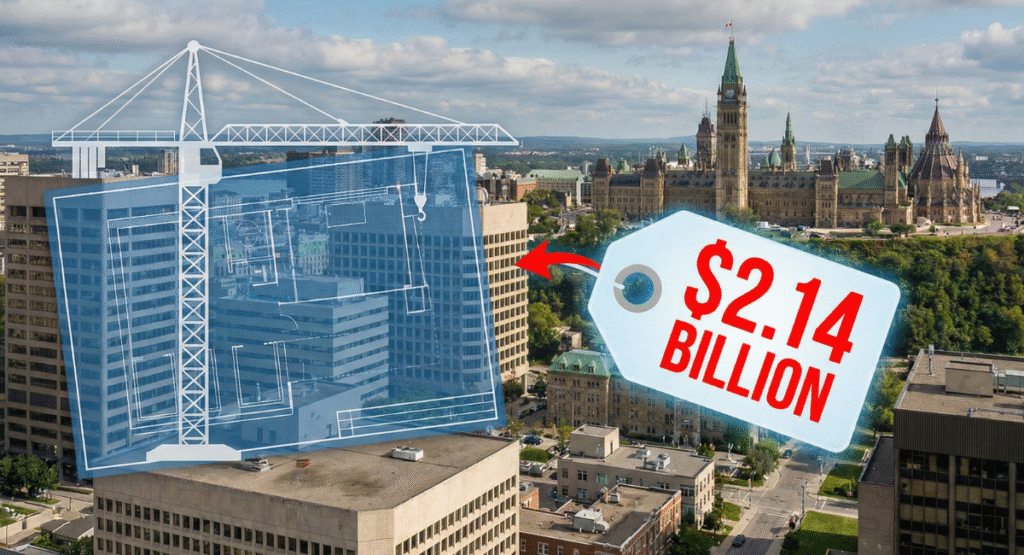
The federal government, Ottawa’s economic anchor and largest employer with 154,000 workers in the National Capital Region, is planning to slash its office footprint by up to 50% over the next decade. Meanwhile, the buildings they’re abandoning sit deteriorating at a cost of $2.14 billion per year to maintain—money hemorrhaging while the city waits for clarity that never seems to arrive.
The Numbers Tell a Troubling Story
Ottawa’s citywide office vacancy rate sits at 12.8% according to recent reports, roughly where it’s been for the past three years. But that number masks a more troubling reality:
- Downtown vacancy rate: 15.7% (up 70 basis points from Q2 2025)
- Federal government office space in NCR: 5.9 million square meters (more than half their national holdings)
- Planned reduction: 25-50% of federal office space over 10 years
- Buildings on disposal list: 10 major properties (none sold yet after 18+ months)
- Annual operating costs for vacant federal buildings: $2.14 billion
For context, the federal government is expected to shed 15-20% of its office space nationwide, which could equate to as much as 8 million square feet in the National Capital Region alone.
Why This Is Different From Past Recessions
Ottawa has weathered economic storms before. During the recessions of the early 1990s and the dot-com bust, the federal government traditionally rescued the office market by absorbing empty space as the economy recovered.
Not this time.
The federal government, now seemingly committed to a hybrid work model, won’t be flocking to occupy empty floors the way they did in the past, according to industry veteran Darren Fleming, CEO of Real Strategy Advisors.
The shift isn’t just about remote work—it’s a fundamental reimagining of how government operates. Federal departments are consolidating into fewer, more modern buildings while divesting aging assets. The old cubicle farms are out; green, accessible, attractive workspaces are in.
The Disposal List: Buildings in Limbo
In May 2023, Public Services and Procurement Canada (PSPC) released a list of 10 buildings it plans to divest in Ottawa-Gatineau. These aren’t small properties—they include:
- L’Esplanade Laurier complex (three buildings taking up an entire downtown city block)
- The Jackson Building at 122 Bank Street
- Brooke Claxton Building at Tunney’s Pasture
- Sir Charles Tupper Building near Mooney’s Bay
- 1500 Bronson Building
- And five other significant properties
The problem? Eight months after the list was released, none of these buildings had hit the market. PSPC says all 10 remain in the “due diligence” phase—conducting environmental studies, heritage assessments, legal reviews, and building appraisals.
The agency warns disposal could take “several years” to complete.
A Downtown Hollowed Out
The implications extend far beyond real estate. Ottawa’s downtown, once the bustling hub of the federal public service, is now described as a shadow of what it used to be, with quieter streets, dark storefronts, and federal office towers standing underused or entirely empty.
This isn’t just pandemic fallout—it represents a sustained disengagement by the federal government from its own capital city over the past five years.
Consider what’s at stake:
For Small Businesses: Thousands of downtown restaurants, cafes, shops, and services depend on federal workers. With fewer people downtown even on mandated office days, many businesses are struggling to survive.
For Transit: OC Transpo, already financially strained, faces declining ridership as fewer federal employees commute daily. Less fare revenue means service cuts, creating a vicious cycle.
For Property Values: Uncertainty about which buildings will be divested and when creates a chilling effect on private investment. Developers can’t plan, landlords can’t renovate, and investors stay on the sidelines.
For Canada’s Image: Ottawa isn’t just a city—it’s the nation’s capital, home to Parliament, the Supreme Court, and over 100 embassies. A hollowed-out downtown sends a troubling message about Canada’s strength on the global stage.
The Flight to Quality: Winners and Losers
Not all office buildings face the same fate. The market is experiencing a dramatic bifurcation:
Class A Properties (Winners):
- Modern, energy-efficient buildings
- Premium amenities and flexible layouts
- Strong ESG credentials
- Locations with easy transit access and parking
Buildings like Constitution Square and 250 Albert Street that have been renovated and modernized are positioned to capture tenant demand.
Class B Properties (At Risk): Industry experts warn that the biggest risk lies with Class B landlords who are simply sitting back and waiting for tenants to come. These older buildings without significant reinvestment face an uncertain future.
Many will need to consider conversion to residential use—a complex and expensive process that’s easier said than done.
Return-to-Office Mandates: A Double-Edged Sword
Recent announcements by major employers including the Province of Ontario, City of Ottawa, Rogers, TD, BMO, RBC, and Scotiabank requiring employees back in the office five days a week have created both hope and complexity.
The upside: More workers downtown could stabilize demand and support struggling businesses.
The downside: Questions remain about whether the federal government could even accommodate and enforce a four- or five-day-a-week return mandate, given their consolidation plans.
Federal departments are planning for more days in the office, but the specifics remain frustratingly vague. The November 2025 budget was expected to provide clarity—it didn’t.
Kanata vs. Downtown: A Tale of Two Markets
While downtown struggles, Ottawa’s tech hub in Kanata tells a different story. The area where tech firms are concentrated saw trailing 12-month net absorption turn positive in Q3 2024 after staying negative since late 2022.
The suburbs are demonstrating resilience as:
- Tech sector expansion gains momentum
- Defence and security companies seek space
- Companies prefer newer, purpose-built facilities
- Parking and highway access attract suburban workers
This geographic split creates a challenging dynamic: downtown needs revitalization while suburban markets show strength.
The Housing Conversion Promise (and Problem)
Politicians and developers see massive potential in converting surplus federal office buildings into desperately needed housing. Some properties are ideal candidates for conversion, while demolishing others could clear prime parcels for mixed-use development.
The federal government has committed $1.1 billion over 10 years to accelerate disposals, with new policies allowing transfer of properties to Canada Lands Company for $1 (instead of market rates) to support affordable housing projects.
But there’s a catch:
The disposal process moves at a glacial pace. PSPC officials aim to complete disposals in 4-5 years—double the typical speed, but still frustratingly slow during a housing crisis.
Add to that:
- Environmental assessments take months or years
- Heritage designations complicate conversions
- Engineering challenges (office buildings lack residential plumbing, proper windows, adequate electrical)
- Financial viability questions (conversion costs can exceed new construction)
Projects like the expansive Confederation Heights site aren’t forecast for construction until 2027 or beyond.
What Landlords Are Doing Now
Smart property owners aren’t waiting for the market to recover. Their strategies include:
1. Aggressive Reinvestment Upgrading HVAC systems, modernizing lobbies, adding amenities like fitness centers and collaboration spaces, improving sustainability credentials.
2. Creative Leasing Offering significant concessions, flexible terms, tenant improvement allowances, and shorter-term deals to attract any activity.
3. Alternative Uses Converting floors to medical offices, educational facilities, non-profit spaces, or data centers. Some are exploring residential conversion feasibility studies.
4. Playing the Long Game Groupe Mach’s approach is instructive: buy office assets at a fraction of replacement value, treat them as cash flow plays, and wait for the eventual recovery with a solid Plan B in place.
As Mach executive Shant Chiara notes, they’re buying assets for long-term value, not betting on a quick market rebound.
Who Might Fill the Gap?
With the federal government shrinking its footprint, where will new office demand come from?
Potential Growth Sectors:
1. Defence and Military Canada’s growing military and defence sector could absorb significant space, especially given Ottawa’s strategic importance and existing defence infrastructure.
2. Banking Sector Potential overflow from Toronto’s tight office market. Several financial institutions are already seeking Ottawa space for back-office operations and regional hubs.
3. Tech Expansion If interest rates continue declining to stimulative levels, business expansion is expected to gain momentum, particularly in Ottawa’s established tech sector.
4. Federal Consolidation Spillover Ironically, as the government concentrates workers in fewer buildings at higher density, some departments may need temporary private space during renovations or transitions.
The Political Dimension: Who’s Accountable?
The Ottawa Board of Trade issued a scathing assessment, arguing the city risks being hollowed out by its anchor employer. Their op-ed posed a challenging question:
If a private company abandoned a community, cutting jobs and leaving behind vacant properties without a proper plan, it would be called out—so why is it acceptable when the government itself does it?
Ottawa Centre Liberal MP Yasir Naqvi agrees the process isn’t moving fast enough: “I don’t think it’s fast enough. I think it needs to be faster. We do have a real housing crisis in our city and we have a real need to revitalize our downtown core.”
But federal officials counter that proper due diligence takes time—environmental assessments, heritage reviews, legal considerations, and consultations with municipalities can’t be rushed without creating bigger problems.
What Ottawa Needs (According to Business Leaders)
The business community has been clear about what would help:
1. A Clear Workforce Strategy Not necessarily a return to five days in-office, but a defined policy that provides certainty for planning and investment.
2. Faster Disposal Process Identify surplus buildings, complete due diligence efficiently, and move properties to market or Canada Lands Company within 2-3 years, not 5-7.
3. Strategic Divestment Sell properties in ways that encourage mixed-use development, new housing, and downtown revitalization—not simply to the highest bidder.
4. Economic Diversification Invest in Ottawa’s transition away from overreliance on the public service, perhaps by designating Ottawa as Canada’s hub for defence and security sectors.
5. Transit and Accessibility Investment Downtown Ottawa continues to face challenges as accessibility issues and limited parking availability weigh on recovery and deter suburban commuters.
The Bottom Line for Property Owners and Investors
If you own or are considering investing in Ottawa commercial real estate, here’s what you need to know:
High Risk:
- Class B downtown office buildings without renovation plans
- Properties dependent on federal government tenants
- Buildings with poor transit access or parking
- Older assets at end of lifecycle
Opportunities:
- Class A downtown properties with recent renovations
- Suburban Kanata tech corridor properties
- Buildings suitable for residential conversion
- Industrial and multi-residential (still strong fundamentals)
- Properties that can accommodate defence/security tenants
Wait-and-See:
- Federal disposal list properties (potential bargains for developers with patience and capital)
- Buildings adjacent to proposed Canada Lands projects
- Assets dependent on return-to-office policy clarity
A City at a Crossroads
Ottawa stands at a pivotal moment. The decisions made over the next 2-3 years about office disposals, return-to-office policies, housing conversions, and economic diversification will shape the capital for decades.
The worst outcome would be continued uncertainty—buildings sitting empty while operating costs pile up, businesses fail, and investors stay away. The best outcome requires bold action from multiple players:
- Federal government: Provide workforce clarity and accelerate disposal timelines
- City of Ottawa: Streamline conversion approvals and support downtown revitalization
- Canada Lands Company: Execute housing projects faster with new tools from the 2024 budget
- Private sector: Invest in quality upgrades and creative repositioning
- Regional partners: Coordinate on transit, housing, and economic development
The stakes are enormous. This isn’t just about office vacancy rates or real estate values—it’s about whether Canada’s capital will thrive or decline, whether downtown Ottawa will transform into a vibrant mixed-use hub or become an increasingly hollowed-out ghost town.
One thing is certain: the days of assuming the federal government will bail out the office market are over. Ottawa must find a new path forward.
Key Takeaways: Ottawa Office Market 2025
Current State:
- 12.8% citywide vacancy (15.7% downtown)
- $2.14B annual cost to maintain federal properties
- 10 buildings on disposal list (none sold yet)
Federal Plans:
- Cut office footprint 25-50% over 10 years
- Consolidate workers into fewer, modern buildings
- Dispose of 8+ million sq ft in National Capital Region
Market Dynamics:
- “Flight to quality” favoring Class A properties
- Class B buildings face conversion or obsolescence
- Kanata tech corridor showing resilience
- Downtown struggling with accessibility and foot traffic
Opportunities:
- Housing conversions (if timelines accelerate)
- Defence/military sector expansion
- Banking sector overflow from Toronto
- Tech sector growth as rates decline
Timeline Reality:
- Disposal process: 4-5 years minimum per property
- Housing conversions: Construction 2027+ for most projects
- Return-to-office clarity: Still undefined after 3 years
Are you a downtown business owner, property investor, or federal employee concerned about Ottawa’s future? Share your experience in the comments. What changes would make the biggest difference for you?
Follow along as this story develops—the decisions made in 2025-2026 will define downtown Ottawa for decades to come.
#OttawaRealEstate #DowntownOttawa #CommercialRealEstate #FederalGovernment #OttawaBusiness #OfficeMarket #UrbanPlanning #OttawaNews